|
|
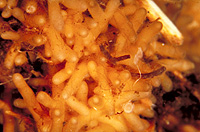
– Enlarged view – |
| • references | |
| Müller W (1994) Betulaerhiza hystrix. In Agerer R (ed) Colour Atlas of Ectomycorrhizae, plate 83, Einhorn-Verlag, Schwäbisch Gmünd. Müller W, Agerer R (1990) Studies on ectomycorrhizae XXXI. Betulaerhiza hystrix, an unidentified ectomycorrhiza on Betula pendula. Crypt Bot 2: 64-68. |
|
| • length | |
| 0 mm | Lower value of unspecified range (could be µ-s.d., but not known) |
| 20 mm | Upper value of unspecified range (could be µ+s.d., but not known) |
| • ramification presence-type | |
| monopodial-pinnate | |
| or | coralloid |
| • ramification orders | |
| 0 | Lower value of unspecified range (could be µ-s.d., but not known) |
| 2 | Upper value of unspecified range (could be µ+s.d., but not known) |
| • abundance | |
| abundant, dense | |
| • main axis diameter | |
| 0.3 mm | Lower value of unspecified range (could be µ-s.d., but not known) |
| 0.5 mm | Upper value of unspecified range (could be µ+s.d., but not known) |
| • rhizomorphs as stout, short, conical structures presence-abundance | |
| absent | |
| • rhizomorphs as short mycorrhiza-like outgrowths with blunt tips presence | |
| absent | |
| • rhizomorphs presence | |
| absent | |
| • shape | |
| straight | |
| or | bent |
| • shape {of distal end} | |
| not inflated, cylindric | |
| • length | |
| 0 mm | Lower value of unspecified range (could be µ-s.d., but not known) |
| 2 mm | Upper value of unspecified range (could be µ+s.d., but not known) |
| 4 mm | Maximum value |
| • diameter | |
| 0.25 mm | Lower value of unspecified range (could be µ-s.d., but not known) |
| 0.4 mm | Upper value of unspecified range (could be µ+s.d., but not known) |
| • colour | |
| brown | |
| or | orange |
| • very tip colour | |
| ochre, yellowish brown | |
| or | whitish |
| • mantle cortical cells visibility | |
| not visible | |
| • mantle {distinct} surface visibility | |
| present | |
| • mantle transparency | |
| not transparent | |
| • mantle laticifers visibility | |
| absent | |
| • mantle dots presence-colour | |
| absent | |
| • mantle carbonizing presence | |
| absent | |
| • mantle surface {in general} habit | |
| shiny | |
| or | not smooth |
| • mantle surface {in detail} kind | |
| densely short-spiny | |
| • emanating hyphae presence | |
| present | |
| • emanating hyphae abundance | |
| abundant | |
| • emanating hyphae distribution | |
| not specifically distributed | |
| • presence | |
| absent | |
| • emanating elements presence-type | |
| cystidia | |
| • emanating elements cystidia location | |
| on outer mantle layer | |
| • presence | |
| absent | |
| • matrix presence | |
| present | |
| • matrix location | |
| outer mantle layer {apart from tip} | |
| • organisation | |
| pseudoparenchymatous | |
| • organisation {if pseudoparenchymatous} cell shape | |
| epidermoid, puzzle-like, jig-saw-shaped | |
| • mantle type | |
| epidermoid cells bearing a hyphal net (type Q) | |
| • hyphal net cells shape | |
| not specialized | |
| • hyphal net cells diameter | |
| 2 µm | Lower value of unspecified range (could be µ-s.d., but not known) |
| 10 µm | Upper value of unspecified range (could be µ+s.d., but not known) |
| • hyphal net cell walls habit | |
| distinct, rather thick | |
| • matrix kind | |
| gelatinous | |
| • septa thickness {relative to cell walls} | |
| thinner than walls | |
| • septa clamps presence | |
| absent | |
| • cell pigment location-colour | |
| absent | |
| and | membranaceously yellowish |
| • cell density | |
| 6 | Mean (= average) |
| • cell wall thickness | |
| 0.2 µm | Lower value of unspecified range (could be µ-s.d., but not known) |
| 3 µm | Upper value of unspecified range (could be µ+s.d., but not known) |
| • cell wall with globular thickenings | |
| absent | |
| • cell wall surface habit | |
| smooth | |
| • cell wall projections presence | |
| absent | |
| • drops of exuded pigment presence | |
| absent | |
| • organisation | |
| pseudoparenchymatous | |
| • cell diameter | |
| 5 µm | Lower value of unspecified range (could be µ-s.d., but not known) |
| 15 µm | Upper value of unspecified range (could be µ+s.d., but not known) |
| • cell length | |
| 15 µm | Lower value of unspecified range (could be µ-s.d., but not known) |
| 25 µm | Upper value of unspecified range (could be µ+s.d., but not known) |
| • cell density | |
| 7 | Mean (= average) |
| • cell contents presence-kind | |
| absent | |
| • cell wall surface habit | |
| smooth | |
| • organisation | |
| plectenchymatous with pseudoparenchymatous nests of cells | |
| • hyphae arrangement | |
| ring-like | |
| • septa clamps presence | |
| absent | |
| • cell diameter | |
| 4 µm | Lower value of unspecified range (could be µ-s.d., but not known) |
| 6 µm | Upper value of unspecified range (could be µ+s.d., but not known) |
| • cell length | |
| 4 µm | Minimum value |
| 20 µm | Lower value of unspecified range (could be µ-s.d., but not known) |
| 60 µm | Upper value of unspecified range (could be µ+s.d., but not known) |
| • anatomy mantle outer mantle layer {of ectomycorrhizal tip} organisation | |
| like other parts of mantle | |
| • anatomy mantle outer mantle layer {of ectomycorrhizal tip} cell density | |
| 11 | Mean (= average) |
| • mantle thickness {apart from tip} | |
| 25 µm | Lower value of unspecified range (could be µ-s.d., but not known) |
| 35 µm | Upper value of unspecified range (could be µ+s.d., but not known) |
| 40 µm | Maximum value |
| • mantle different layers presence | |
| discernable | |
| • outer mantle layer organisation | |
| pseudoparenchymatous | |
| • middle mantle layer organisation | |
| pseudoparenchymatous | |
| • inner mantle layer organisation | |
| plectenchymatous | |
| • unlayered mantle hyphae radially diameter | |
| 4 µm | Lower value of unspecified range (could be µ-s.d., but not known) |
| 8 µm | Upper value of unspecified range (could be µ+s.d., but not known) |
| • presence | |
| absent | |
| • anatomy mantle longitudinal section cortical (epidermal) cells shape | |
| tangentially-oval to -elliptic or -cylindrical, and oriented obliquely | |
| • anatomy mantle longitudinal section cortical (epidermal) cells tangentially length | |
| 10 µm | Lower value of unspecified range (could be µ-s.d., but not known) |
| 25 µm | Upper value of unspecified range (could be µ+s.d., but not known) |
| • anatomy mantle longitudinal section cortical (epidermal) cells radially diameter | |
| 60 µm | Lower value of unspecified range (could be µ-s.d., but not known) |
| 80 µm | Upper value of unspecified range (could be µ+s.d., but not known) |
| • presence | |
| present | |
| • kind | |
| paraepidermal | |
| • mantle different layers presence | |
| discernible | |
| • outer mantle layer organisation | |
| pseudoparenchymatous | |
| • outer mantle layer hyphae radially diameter | |
| 4 µm | Lower value of unspecified range (could be µ-s.d., but not known) |
| 8 µm | Upper value of unspecified range (could be µ+s.d., but not known) |
| • middle mantle layer organisation | |
| pseudoparenchymatous | |
| • middle mantle layer hyphae radially diameter | |
| 4 µm | Lower value of unspecified range (could be µ-s.d., but not known) |
| 8 µm | Upper value of unspecified range (could be µ+s.d., but not known) |
| • inner mantle layer organisation | |
| plectenchymatous | |
| • inner mantle layer hyphae radially diameter | |
| 4 µm | Lower value of unspecified range (could be µ-s.d., but not known) |
| 8 µm | Upper value of unspecified range (could be µ+s.d., but not known) |
| • presence | |
| absent | |
| • presence | |
| present | |
| • kind | |
| apparently one and a half row deep | |
| • anatomy mantle cross-section hyphal cells around cortical (epidermal) cells shape | |
| roundish | |
| or | beaded |
| • anatomy mantle cross-section hyphal cells around cortical (epidermal) cells thickness | |
| 2 µm | Mean (= average) |
| 4 µm | Maximum value |
| • structure {in plan view} | |
| of palmetti type | |
| • intrahyphal hyphae clamps presence | |
| absent | |
| • type | |
| awl-shaped, bristle-like (type A) | |
| • ramification presence-position | |
| absent | |
| • septa presence | |
| present | |
| • septa kind | |
| simple | |
| • diameter {proximal} | |
| 3.5 µm | Lower value of unspecified range (could be µ-s.d., but not known) |
| 5 µm | Upper value of unspecified range (could be µ+s.d., but not known) |
| • diameter {distal} | |
| 1.5 µm | Lower value of unspecified range (could be µ-s.d., but not known) |
| 2.5 µm | Upper value of unspecified range (could be µ+s.d., but not known) |
| • length | |
| 75 µm | Lower value of unspecified range (could be µ-s.d., but not known) |
| 100 µm | Upper value of unspecified range (could be µ+s.d., but not known) |
| 135 µm | Maximum value |
| • cell wall thickness | |
| 0.5 µm | Lower value of unspecified range (could be µ-s.d., but not known) |
| 1 µm | Upper value of unspecified range (could be µ+s.d., but not known) |
| • cell wall thickness {relative to mantle cells} | |
| thicker | |
| • cell wall evenness | |
| even in thickness | |
| • surface habit | |
| smooth | |
| • contents presence | |
| absent | |
| • contents type | |
| absent | |
| • shape | |
| not striking | |
| • cell pigment location-colour | |
| absent | |
| • clamps presence | |
| absent | |
| • anatomy emanating elements emanating hyphae cell diameter | |
| 4 µm | Mean (= average) |
| • type | |
| lacking, only emanating hyphae present (type G) |
|
| • anatomy emanating elements rhizomorphs clamps presence | |
| absent | |
| • anatomy emanating elements rhizomorphs clamps presence | |
| absent | |
| • anatomy emanating elements rhizomorphs clamps presence | |
| absent | |
| • anatomy emanating elements rhizomorphs clamps presence | |
| absent | |
| • anatomy emanating elements rhizomorphs clamps presence | |
| absent | |
| • presence | |
| absent | |
| • {of ectomycorrhiza former} presence | |
| absent | |
| • {of foreign origin} presence | |
| absent | |
| • number {per cell} | |
| 2 | Mean (= average) |
| • geographic occurrence continent | |
| Europe | |
| • plant family | |
| Betulaceae | |
| • plant genus | |
| Betula | |
| • plant habitat kind | |
| forests, woods | |